International money transfers are one of the most consistently overpriced financial services available to consumers and businesses. The combination of exchange rate markups, fixed transfer fees, correspondent bank charges, and receiving bank fees means that the true cost of sending money across borders is frequently two to four times higher than what the headline fee suggests — and in many cases, the person sending the money has no idea how much is actually being lost.

This guide explains exactly where that money goes, which legal methods consistently deliver the best rates, how to compare options accurately, and how to build a transfer strategy that minimizes costs without compromising speed, reliability, or compliance.
Where Your Money Actually Goes: Understanding the True Cost of International Transfers
Before examining how to reduce transfer fees, it is essential to understand the full cost structure of international money transfers — because the fee advertised on the sending platform is almost never the total cost of the transaction. Most people sending money internationally focus on the explicit transfer fee and overlook the exchange rate margin, which is typically the larger of the two costs and significantly harder to see without active comparison.
The Exchange Rate Margin: The Hidden Cost
Every currency exchange involves two rates: the mid-market rate (also called the interbank rate or real exchange rate) and the retail rate offered by banks, transfer services, and currency exchange providers. The mid-market rate is the midpoint between the buy and sell prices in the global currency markets — the rate you see quoted on Google, Reuters, or Bloomberg. It is the rate at which banks trade currency with each other. Retail providers do not offer this rate to consumers; they apply a markup — adding a percentage above the mid-market rate for currency purchases and subtracting a percentage for currency sales — and retain the difference as profit.
This exchange rate margin varies dramatically across providers. Traditional banks typically apply margins of 2.5–4% on major currency pairs and significantly higher on exotic currencies. Currency exchange booths at airports and hotels frequently apply margins of 7–12%. Modern digital money transfer platforms have compressed margins to 0.3–1.5% for major currency pairs. On a $5,000 transfer, the difference between a 3.5% bank margin and a 0.5% digital platform margin is $150 — a cost that is entirely invisible if you only look at the transfer fee line.
Explicit Transfer Fees
Transfer fees are the charges explicitly labeled as the cost of sending the transfer. These vary from zero (on some digital platforms for transfers above minimum amounts) to $25–$50 for international wire transfers at major banks. While these fees are visible and easy to compare, they can be misleading when evaluated in isolation — a service with a zero transfer fee but a 3% exchange rate margin will cost significantly more on a large transfer than a service charging a $10 fee with a 0.4% margin.
Correspondent Bank Fees
When a bank in one country sends a wire transfer to a bank in another country, the transaction often travels through one or more intermediary banks — called correspondent banks — before reaching the destination. Each correspondent bank in the chain may deduct its own processing fee from the transfer amount, reducing what the recipient receives. These fees are typically $10–$25 per correspondent bank, are often undisclosed at the time of sending, and are deducted from the transfer amount rather than charged upfront — meaning the recipient receives less than expected with no advance warning. Transfers between countries without direct banking relationships may pass through two or three correspondent banks, each deducting fees.
Receiving Bank Fees
Many banks charge a fee to receive an incoming international wire transfer — typically $10–$20, deducted from the received amount. This fee is charged by the recipient’s bank, not the sender’s, and is often not visible to the sender at all. For recipients who receive regular international payments, these receiving fees accumulate into significant costs over time.
The total cost awareness framework: when comparing international transfer options, always calculate the total cost as the sum of all four components — exchange rate margin (compared against the mid-market rate), explicit transfer fee, estimated correspondent bank fees, and receiving bank fees. Only with all four components included can you make a genuinely cost-informed comparison.
Modern Digital Money Transfer Platforms: The Benchmark for Cost Efficiency
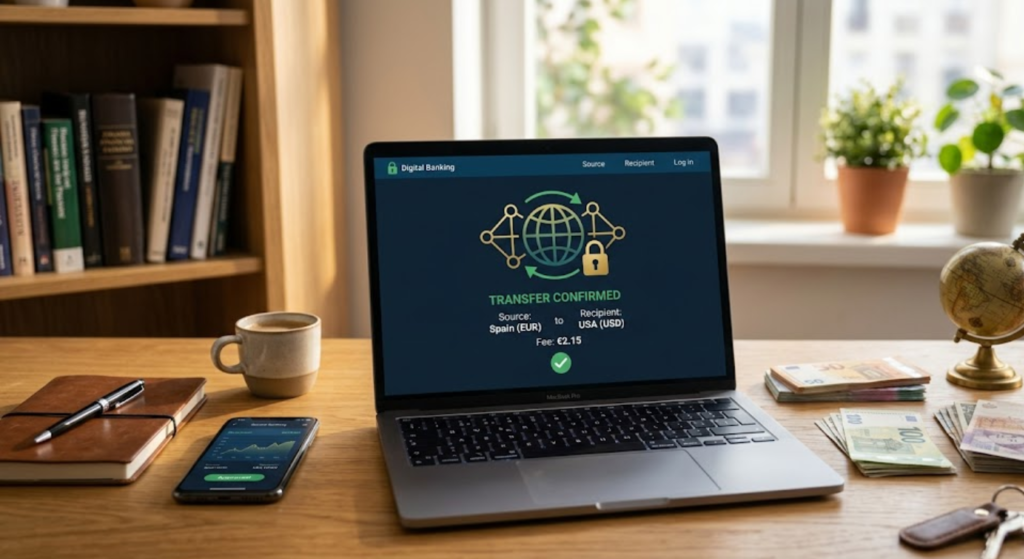
The emergence of dedicated international money transfer platforms over the past decade has fundamentally changed the cost structure of cross-border payments for consumers and small businesses. By building technology infrastructure specifically for currency exchange and international payments — rather than as a secondary service on top of a domestic banking operation — these platforms have achieved exchange rate margins and fee structures that traditional banks cannot economically match with their existing infrastructure.
How Digital Platforms Achieve Lower Costs
The cost advantage of digital transfer platforms comes from several sources. First, they operate without the branch networks, correspondent banking relationships, and legacy infrastructure that impose fixed costs on traditional banks. Second, the largest platforms process high volumes of transfers in both directions between major currency corridors — meaning they can often match a customer wanting to send USD to EUR against a customer wanting to send EUR to USD, without either party’s funds ever crossing borders in the traditional sense. This internal matching eliminates correspondent bank fees and allows the platform to offer near-mid-market exchange rates. Third, their digital-only operations allow them to serve customers at marginal costs that physical bank branches make impossible.
Key Features to Compare Across Platforms
Not all digital transfer platforms are equivalent, and the best option for a specific transfer depends on several factors: the currency pair involved (platforms vary significantly in their competitiveness across different currency corridors), the transfer amount (some platforms offer better rates on larger amounts while others have minimum fees that make them expensive for small transfers), the delivery speed required (same-day or next-day delivery may carry a premium versus the standard delivery time), and the payment method (bank-to-bank transfers typically offer better rates than debit or credit card funded transfers, which carry card processing costs).
The most reliable way to compare digital platforms is through independent comparison websites that calculate the total cost of a specific transfer amount between specific currencies in real time — showing both the exchange rate offered and the explicit fee, allowing a true total cost comparison. Given that exchange rates and fees change frequently, any comparison should be done at the time of the actual transfer rather than based on historical research.
Multi-Currency Accounts: Holding Funds in Multiple Currencies to Eliminate Repeated Conversions
For businesses or individuals who regularly send or receive money in multiple currencies, one of the most effective cost reduction strategies is maintaining balances in the relevant currencies rather than converting each transaction individually. Every currency conversion incurs an exchange rate margin — the cost of converting multiple small amounts is significantly higher than converting one larger amount, and converting at all when timing is unfavorable adds foreign exchange risk to the cost equation.
How Multi-Currency Accounts Work
Multi-currency accounts allow the holder to maintain balances in multiple currencies within a single account structure, receive payments in those currencies without triggering conversion, and pay in the appropriate currency when needed. A business that sells to customers in Europe and the UK, for example, can receive EUR and GBP payments into dedicated currency balances, use those balances to pay EUR and GBP suppliers directly without conversion, and convert only the net surplus to their domestic currency at a timing and rate of their choosing.
Several digital banking platforms and specialist currency providers offer multi-currency account functionality specifically designed for businesses and frequent international travelers. These accounts typically allow the holder to receive payments using local bank account details in multiple countries — a US business can provide European customers with a genuine EUR IBAN for local payment purposes, eliminating the international transfer entirely on the receiving side.
The Cost Reduction Logic
The cost reduction from multi-currency accounts operates through three mechanisms. First, by receiving payments in local currency, the business eliminates the exchange rate margin on the receiving transaction — the customer pays in EUR, the EUR arrives in the EUR balance without conversion. Second, by paying suppliers in their local currency from the matching balance, the business eliminates the exchange rate margin on the outbound transaction as well. Third, by converting only the net position — the surplus after matching inflows and outflows in each currency — the business converts a smaller total amount, reducing total conversion costs, and can time the conversion to favorable rate conditions rather than converting immediately at whatever rate is available at the moment of each transaction.
Batch Transfers: Reducing Per-Transaction Costs Through Consolidation
For businesses making regular international payments — payroll to international employees or contractors, regular supplier payments, or recurring service fees — consolidating multiple smaller transfers into single larger transfers significantly reduces both the per-transaction fee costs and, in some cases, the exchange rate margin (as many providers offer better rates on larger transfer amounts).
The mechanics are straightforward: rather than sending weekly payments of $500 to four international contractors, a business makes a single $2,000 transfer monthly, potentially at a better exchange rate, with a single fixed fee rather than four. For businesses using transfer platforms with percentage-based fees capped at a maximum, batching also ensures that fewer transfers hit the maximum fee rather than the percentage-based rate that applies to smaller amounts.
Batch transfer functionality is offered by most business-oriented international payment platforms, allowing a single transfer instruction to be split among multiple recipients in the destination country — reducing both the administrative burden and the total cost of regular international payment programs. Payroll platforms serving international teams often include multi-currency batch payment capabilities specifically designed for this use case.
Forward Contracts and Rate Lock Options for Business Transfers
For businesses with predictable future currency needs — a UK company that knows it will need to pay a US supplier $50,000 in three months, or an importer with a scheduled overseas purchase — forward contracts allow the business to lock in an exchange rate today for a transaction that will occur in the future. This is not speculation — it is risk management that also provides cost certainty.
How Forward Contracts Work
A forward contract is an agreement between the business and a currency provider to exchange a specified amount of currency at a specified rate on a specified future date. The rate is agreed today, typically at or near the current mid-market rate with the provider’s normal margin, and the business knows exactly what they will pay regardless of how the exchange rate moves between now and the settlement date.
The cost benefit of forward contracts is not primarily about getting a better rate than spot — the forward rate reflects market expectations of where the rate will be at the future date, which may be slightly better or worse than today’s spot rate depending on interest rate differentials between the two currencies. The benefit is certainty: the business eliminates the risk that an adverse exchange rate movement will increase their costs, making budgeting, pricing, and margin calculation reliable. For businesses where the exchange rate is a significant variable in their cost structure, this certainty has genuine financial value independent of whether the forward rate proves better or worse than the eventual spot rate.
Forward contracts are offered by specialist currency brokers and many business-oriented transfer platforms at no explicit additional fee — the provider’s margin is embedded in the agreed forward rate. Minimum transfer amounts typically apply, making forward contracts most appropriate for business transfers of $5,000 or more.
Rate Alerts as a Cost Optimization Tool
For transfers that are not time-critical, rate alert services — available through most digital transfer platforms — allow the user to specify a target exchange rate and receive notification when that rate becomes available. Rather than converting at whatever rate is available on the day a transfer becomes necessary, the user sets a target rate that represents acceptable value, monitors the market passively, and executes the transfer when the market reaches the target. This approach requires flexibility in timing but can produce meaningfully better rates than transferring at arbitrary times without market monitoring.
Cryptocurrency and Blockchain-Based Transfers: Opportunities and Limitations
Blockchain-based payment rails have emerged as a genuine alternative for certain international payment use cases, offering near-instant settlement at costs that can be significantly lower than traditional wire transfers for specific corridors and amounts. Understanding where this method adds value — and where its limitations make it inappropriate — allows businesses and individuals to evaluate it accurately rather than dismissing it or over-applying it.

Where Blockchain-Based Transfers Add Value
The efficiency of blockchain-based payments is most pronounced in corridors where traditional banking infrastructure is limited or expensive — transfers to and from countries with underdeveloped correspondent banking networks, high traditional wire fees, or currency restrictions that make conventional transfers slow and costly. For recipients in these markets, stablecoin-based transfers (using cryptocurrencies pegged to major currencies to eliminate volatility) that settle to local currency through local exchange networks can arrive faster and at significantly lower total cost than traditional wire transfers.
For business-to-business transfers between parties who both have established cryptocurrency infrastructure — wallets, exchange relationships, and compliance processes — blockchain settlement can eliminate correspondent bank fees and exchange rate margins through direct peer-to-peer settlement. Several blockchain payment platforms have built regulated, compliant infrastructure specifically for international business payments that provides the settlement efficiency of blockchain with the compliance, reporting, and audit trail requirements of corporate treasury operations.
Limitations That Cannot Be Ignored
Blockchain-based international payments are not universally superior to traditional methods, and several limitations must be considered before adopting them for regular use. Regulatory compliance requirements — KYC (Know Your Customer), AML (Anti-Money Laundering), and tax reporting obligations — apply to cryptocurrency-denominated transfers in most jurisdictions and require infrastructure and processes that not all businesses have. Exchange rate volatility in non-stablecoin cryptocurrencies creates financial risk that is entirely absent in fiat currency transfers, making them inappropriate for any transfer where the receiving amount needs to be predictable. Recipient infrastructure requirements — the recipient must have or be willing to establish cryptocurrency wallet and exchange capabilities — limit the practical applicability to business-to-business relationships where both parties are prepared to adopt the required tools.
Regulatory Compliance: Why Legal Cost Reduction Is the Only Cost Reduction
Any discussion of reducing international transfer fees must explicitly address the regulatory framework within which all legitimate cost reduction strategies must operate — because the consequences of using methods that circumvent currency controls, reporting requirements, or tax obligations are significantly more costly than any fee savings achieved.
Reporting Thresholds and Obligations
Most jurisdictions impose reporting requirements on international transfers above specified thresholds. In the United States, bank transfers above $10,000 trigger automatic Currency Transaction Reports (CTRs) filed with the Financial Crimes Enforcement Network (FinCEN). International transfers may also require FBAR (Foreign Bank and Financial Accounts Report) filing if the aggregate value of foreign accounts exceeds $10,000 at any point during the year. Businesses with significant international payment volumes may have additional FBAR, Form 8938, and Form 5471 obligations depending on the nature and structure of their international activities.
Structuring transactions specifically to avoid reporting thresholds — sending multiple transfers just below $10,000 rather than a single transfer above it — is a federal crime in the United States regardless of whether the underlying funds are legitimate. The intent to avoid the reporting requirement, not the legitimacy of the funds, is what constitutes the offense. Every cost reduction strategy discussed in this article operates fully within and above all applicable reporting thresholds and requirements.
KYC and AML Requirements
All regulated financial services — banks, licensed money transfer operators, and digital payment platforms operating in regulated markets — are required to verify the identity of their customers and monitor transactions for indicators of money laundering and financial crime. These Know Your Customer (KYC) and Anti-Money Laundering (AML) processes are legal requirements, not optional procedures. Attempting to use services that bypass these requirements — unlicensed money transfer operators, informal value transfer systems, or unregulated cryptocurrency platforms — to avoid fees or oversight is not a cost reduction strategy. It is a legal exposure that can result in criminal prosecution, asset seizure, and the loss of legitimate banking relationships.
The legitimate cost reduction strategies in this article use fully regulated, licensed providers whose compliance with KYC and AML requirements is verifiable through their regulatory registrations. Using regulated providers costs more than using unregulated alternatives — and it is the only appropriate choice for any individual or business operating within the law.
A Practical Framework for Minimizing Transfer Costs
Bringing together the strategies covered in this article, the following framework provides a practical sequence for any individual or business seeking to minimize international transfer costs legally and systematically.
Step 1: Calculate Your Current True Cost
Before optimizing, measure what you are currently paying. For your most recent international transfers, calculate the total cost: find the mid-market rate at the time of transfer, compare it to the rate you actually received, express the difference as a percentage, and add any explicit fees. Most people discover that their true total cost is significantly higher than the headline fee they were aware of.
Step 2: Identify Your Transfer Profile
Different transfer profiles benefit from different optimization strategies. Regular, predictable payments to the same recipients benefit most from batch consolidation and multi-currency accounts. Large, occasional transfers benefit most from platform comparison and potentially forward contracts for business transfers. Transfers to underbanked corridors may benefit from investigating blockchain-based alternatives. Frequent small transfers benefit most from platforms with low or zero fixed fees and competitive exchange rate margins.
Step 3: Open Accounts on Two or Three Competitive Platforms
No single platform is consistently best across all currency pairs, transfer amounts, and timing requirements. Maintaining verified accounts on two or three competitive digital transfer platforms allows real-time comparison at the moment of each transfer rather than defaulting to a single provider regardless of its current rate competitiveness. The account setup process is a one-time investment; the ongoing benefit is the ability to choose the most competitive option for each specific transfer.
Step 4: Match the Method to the Transfer
Apply the appropriate tool to each transfer type: digital platform for cost-optimized one-time transfers; multi-currency account for businesses with matching inflows and outflows; batch transfers for regular payroll or supplier payment programs; forward contracts for known future large business currency needs; rate alerts for non-time-critical transfers with flexibility on timing.
Step 5: Document and Review Annually
International transfer costs are not static — platform fee structures change, new providers enter the market, exchange rate margin competitiveness shifts, and your own transfer profile evolves. An annual review of the platforms you use, the fees you are paying, and the alternatives available ensures that optimization achieved today doesn’t erode as the market changes around you.
The Bottom Line
International transfer fees are not fixed costs that must be accepted. They are variable costs determined by the combination of provider selection, transfer method, timing strategy, and structural account setup — and for most individuals and businesses, the gap between what they currently pay and what is achievable through informed, deliberate provider and method selection is significant.
The strategies in this article are not loopholes or workarounds. They are the natural result of understanding how international payment pricing works, which providers have built genuinely efficient infrastructure, and how to match the right tool to each transfer type. Every method described is fully legal, fully regulated, and fully transparent — the cost reduction comes from knowledge and deliberate choice, not from circumventing the financial system.
Start by measuring your current true cost. The number will likely motivate everything that comes next.
Disclaimer: This article is for educational and informational purposes only and does not constitute financial, tax, or legal advice. International transfer regulations, reporting requirements, and tax obligations vary by jurisdiction and individual circumstances. Always consult a qualified financial advisor, tax professional, or legal counsel for guidance specific to your situation before making decisions about international money transfers.