Choosing the wrong payment platform costs businesses money every single month — not dramatically, not in a way that triggers an immediate crisis, but steadily and consistently through fees that were never fully understood at onboarding and pricing structures that favor the processor far more than the merchant in specific transaction scenarios.

This analysis examines the true cost structures of the major payment platforms available to merchants globally in 2026, compares their pricing across realistic merchant use cases, and provides the analytical framework needed to make a payment platform decision based on actual cost rather than brand familiarity or simplest onboarding experience.
Important note: Payment platform fees change frequently. The figures in this article reflect publicly available pricing as of early 2026. Always verify current rates directly with each provider before making a final decision, as promotional pricing, regional variations, and recent updates may differ from what is published here.
The Problem With Headline Fees
Every payment platform leads with its headline rate. “2.9% + $0.30.” “1.9% for in-person.” “0% transfer fees.” These numbers are real, but they represent only one dimension of a multi-layered cost structure that, in aggregate, determines what a business actually pays to accept payments. Merchants who choose platforms based on headline rates without analyzing the full fee structure routinely discover that their effective rate — total fees divided by total payment volume — differs significantly from what they expected.
The effective rate is the only number that matters for comparing payment platforms. It accounts for every fee the merchant pays: transaction percentage fees, per-transaction fixed fees, monthly platform fees, chargeback fees, international card fees, currency conversion fees, and any other charges that the platform applies to a merchant’s specific transaction profile. Calculating the effective rate for a realistic representation of your own transaction mix — not an idealized scenario constructed by the processor’s pricing page — is the starting point for any genuine platform comparison.
This analysis calculates effective rates across multiple merchant profiles to illustrate where different platforms are genuinely competitive and where their pricing structures impose costs that are easy to miss until they appear on a monthly statement.
The Major Global Payment Platforms: Fee Structure Overview
Stripe
Stripe remains the dominant choice for developer-driven e-commerce and software businesses globally, with pricing designed for transparency and predictability across a wide range of use cases.
Standard online transaction fees (US): 2.9% + $0.30 per successful card transaction. International cards add 1.5%. Currency conversion adds 1.0% if currency conversion is required. American Express transactions are included at the same rate as other cards.
In-person transactions: 2.7% + $0.05 per transaction using Stripe Terminal hardware.
ACH/bank debit: 0.8% capped at $5.00 — significantly lower than card processing for higher-value transactions.
Stripe Billing (subscriptions): Standard card processing fees apply plus 0.5–0.8% for automated billing management depending on the pricing tier.
Custom pricing: Available for merchants processing above approximately $250,000 per year, though Stripe does not publish the threshold or the discount. Negotiated rates typically begin at interchange plus 0.6–0.8% + $0.10–$0.20 for volume merchants.
Chargeback fee: $15 per dispute, refunded if the merchant wins.
Radar fraud protection: Included in standard pricing for basic rules; Radar for Fraud Teams (advanced machine learning) adds $0.02 per transaction.
Where Stripe is most cost-effective: Developer-centric businesses, SaaS and subscription companies, global e-commerce with multi-currency requirements, and businesses that value platform breadth (Stripe offers issuing, treasury, tax, and identity products) over minimum processing cost.
Where Stripe is less competitive: High-volume in-person retail where Square’s hardware ecosystem offers a more integrated solution; businesses with very high average transaction values where the per-transaction $0.30 fixed fee becomes negligible but the percentage rate may be negotiable elsewhere; and very high-volume merchants who can achieve better rates through a direct acquiring relationship.
Square
Square built its market position on accessible in-person payment processing for small businesses and has expanded into a broader business management platform encompassing POS software, payroll, marketing, and banking.
In-person transactions: 2.6% + $0.10 per tap, dip, or swipe. This rate applies to all card types including American Express.
Online transactions: 2.9% + $0.30 per transaction — identical to Stripe for most online payments.
Manually entered transactions: 3.5% + $0.15 — a significant premium for card-not-present transactions entered manually, relevant for phone orders and invoicing.
Square Invoices: 3.3% + $0.30 for card payments on invoices.
Square for Restaurants / Retail: Industry-specific POS software available on subscription tiers ranging from free (with standard processing rates) to $60–$165 per month for premium tiers with advanced features and potentially reduced processing rates.
Chargeback fee: No chargeback fee — Square absorbs this cost, which is a meaningful differentiator for merchants with elevated dispute rates.
Where Square is most cost-effective: Physical retail and food service businesses where the integrated POS hardware and software ecosystem provides value beyond pure payment processing; small businesses that benefit from Square’s no-monthly-fee structure; businesses where the free chargeback dispute handling represents meaningful cost savings.
Where Square is less competitive: Online-first businesses where Stripe’s developer tools and API capabilities offer more flexibility; enterprise merchants where negotiated custom pricing is available through other providers; businesses with high volumes of invoice payments where the 3.3% rate applies.
PayPal and Braintree
PayPal operates at two distinct market levels: the consumer-facing PayPal checkout button that drives conversion through consumer recognition and trust, and Braintree (PayPal’s developer-focused acquiring platform) which serves enterprise and high-growth businesses through a more flexible API-first approach.
PayPal standard checkout (merchants): 3.49% + $0.49 per transaction for standard PayPal checkout (higher than Stripe or Square for equivalent card transactions, reflecting the brand premium and consumer trust conversion benefit). Card processing through PayPal checkout is 2.99% + $0.49.
PayPal advanced checkout (card fields): 2.89% + $0.49 for card payments through custom card fields, bringing card processing closer to Stripe pricing while retaining PayPal infrastructure.
PayPal Zettle (in-person): 1.75% per in-person transaction in the UK and Europe — significantly lower than US rates, reflecting different interchange environments. US in-person rate is 2.29% + $0.09.
Braintree: 2.59% + $0.49 for cards and digital wallets; custom pricing available for merchants above $80,000 per month in processing volume. PayPal-funded transactions through Braintree are 3.49% + $0.49.
International transactions: Additional 1.5% for cross-border transactions, plus currency conversion fees that vary by currency pair.
Where PayPal is most cost-effective: Businesses where PayPal checkout recognition meaningfully improves conversion rates (the conversion premium can offset higher processing fees if the incremental revenue exceeds the incremental cost); marketplaces that need PayPal’s established consumer brand; businesses serving demographics with high PayPal wallet penetration.
Where PayPal is less competitive: Pure card processing where Stripe and Square offer lower all-in rates; businesses without the demographic characteristics that make PayPal checkout conversion-accretive; high-volume merchants where Braintree’s pricing becomes competitive but requires separate onboarding and integration.
Adyen
Adyen is the enterprise payment platform that processes transactions for major global companies — marketplaces, airlines, global retail chains, and large e-commerce platforms. Its pricing model differs fundamentally from consumer-facing payment platforms: Adyen charges on an interchange plus basis with a processing fee per transaction rather than a blended percentage rate.

Pricing structure: Interchange plus 0.3% + €0.11 (approximately $0.12) per transaction for most card types in the EU. US processing is interchange plus with a per-transaction fee structure that varies by card type and transaction channel. Adyen does not publish a standardized US rate sheet because its pricing is negotiated based on volume, industry, and risk profile.
Minimum volume: Adyen requires significant processing volume — typically $1 million or more annually — to make the onboarding investment worthwhile. The platform is not designed for small or micro-merchants.
Global coverage: Adyen processes in 150 currencies across 200+ payment methods globally, with local acquiring in 40+ countries — reducing the cross-border surcharges that apply when transactions are processed through a foreign acquirer.
Chargeback fee: €5–€10 per dispute depending on the scheme.
Where Adyen is most cost-effective: Global enterprises with high transaction volumes who benefit from local acquiring in multiple markets, interchange plus transparency, and the platform’s unified global reporting and reconciliation capabilities. The total cost at enterprise volumes is typically significantly lower than flat-rate alternatives.
Where Adyen is less competitive: Any merchant below approximately $1 million in annual processing volume; businesses needing simple, fast onboarding; and US-focused businesses without significant international complexity.
Worldpay
Worldpay (now part of FIS and in the process of being spun off as an independent entity) is one of the largest acquiring banks globally, processing for merchants of all sizes with a particular strength in large enterprise and omnichannel retail.
Pricing: Worldpay uses interchange plus pricing for larger merchants and blended rate pricing for smaller merchants, with rates negotiated based on volume, industry, and risk profile. Published small business rates in the US typically range from 2.9% + $0.30 for online transactions to 2.7% for in-person, but enterprise rates are entirely negotiated.
Monthly fees: Worldpay charges monthly account maintenance fees, statement fees, and in some configurations PCI compliance fees that add to the effective cost for lower-volume merchants.
International strength: Worldpay’s global acquiring footprint is one of the largest available, with direct acquiring relationships in more than 40 markets — reducing cross-border fees for merchants with multinational operations.
Checkout.com
Checkout.com has positioned itself as the premium payment infrastructure provider for high-growth global enterprises, with particular strength in Asia-Pacific, the Middle East, and emerging markets where its local acquiring relationships reduce the cost and complexity of cross-border processing.
Pricing: Checkout.com uses interchange plus pricing with a negotiated processing markup, typically 0.2–0.4% plus a per-transaction fee for enterprise clients. Minimum volume requirements apply, typically $1 million or more annually.
Differentiation: Strong local acquiring coverage in markets where other processors route transactions as cross-border, meaningfully reducing fees. Particularly competitive for businesses with significant transaction volumes in the Middle East, Southeast Asia, and Latin America.
True Cost Analysis: Three Merchant Profiles
Abstract fee comparisons are less useful than scenario-based analysis calibrated to specific merchant types. The following three profiles illustrate how platform choice interacts with transaction characteristics to determine actual costs.
Profile 1: E-Commerce Store — $30,000/Month, Average Order $65
This profile represents a typical small e-commerce business: approximately 460 transactions per month, predominantly domestic card transactions, with 15% international cards and minimal in-person sales.
At Stripe standard pricing (2.9% + $0.30): monthly processing fees of approximately $1,008. This breaks down as $870 in percentage fees and $138 in per-transaction fees. International card surcharge adds approximately $66 (1.5% on 15% of volume). Total estimated monthly cost: approximately $1,074, representing an effective rate of 3.58%.
At Square online pricing (2.9% + $0.30): essentially identical for domestic card transactions. Square offers no meaningful cost advantage for online-only merchants versus Stripe at this volume.
At PayPal advanced checkout (2.89% + $0.49): the lower percentage (2.89% vs. 2.9%) is more than offset by the higher per-transaction fee ($0.49 vs. $0.30 per transaction). Total estimated monthly cost: approximately $1,091, representing an effective rate of 3.64% — slightly higher than Stripe.
At Stripe with negotiated pricing (interchange + 0.7% + $0.15): at this volume, negotiated pricing may not yet be available, but if achieved, the effective rate would drop to approximately 2.4–2.8% depending on the card mix — a saving of $240–$350 per month.
The primary cost lever for this merchant profile is not platform selection at current volume — all major flat-rate platforms are similarly priced — but growth toward the volume thresholds where interchange plus pricing becomes available and meaningfully reduces costs.
Profile 2: Physical Retail — $80,000/Month, Average Transaction $45, Mixed Card Types
This profile represents a mid-sized physical retail business with a typical card mix including regulated debit (lower interchange), standard credit, and premium rewards credit cards.
At Square in-person pricing (2.6% + $0.10): monthly processing fees of approximately $2,124. This includes $2,080 in percentage fees and approximately $178 in per-transaction fees across roughly 1,778 transactions. Total effective rate: 2.66%.
At Stripe Terminal (2.7% + $0.05): slightly higher percentage but lower per-transaction fee. For this transaction profile, the effective rate is approximately 2.72% — marginally higher than Square.
At interchange plus pricing through a regional acquirer or Adyen at sufficient volume (estimated average interchange 1.6% + 0.3% + $0.10): effective rate approximately 2.1–2.3%, representing a saving of $280–$480 per month versus flat-rate platforms — $3,360–$5,760 per year.
For this merchant profile, the business case for pursuing interchange plus pricing through direct acquiring is clear. At $80,000 per month in volume, the annual savings justify the additional complexity of the onboarding process and the ongoing work of monitoring interchange fees and reconciling monthly statements.
Profile 3: SaaS Business — $200,000/Month, 60% Annual Subscriptions, 40% Monthly
This profile represents a B2B software company with a mix of annual subscriptions (paid upfront by card) and monthly recurring billing, high average transaction values ($800 average), and minimal chargeback risk.
At Stripe Billing (2.9% + $0.30 + 0.5% for billing): effective rate including the billing premium is approximately 3.4%. Monthly processing cost: approximately $6,800.
At Stripe with Billing at negotiated rates (interchange + 0.7% + 0.4% billing + $0.10): at $200,000/month volume, negotiated rates are available. Estimated effective rate: approximately 2.6–2.8%. Monthly processing cost: approximately $5,200–$5,600. Annual saving versus standard pricing: $14,400–$19,200.
For this merchant profile, the priority action is initiating pricing negotiations with Stripe or evaluating Braintree or Adyen as alternatives that may offer more competitive custom pricing at this volume. The high average transaction value makes the per-transaction fixed fee relatively immaterial, so the focus should be on negotiating the percentage rate down.
International Merchant Considerations: Regional Pricing Variations
Payment platform pricing varies significantly by region, and merchants operating across multiple geographies must account for regional fee differences rather than assuming domestic pricing applies globally.
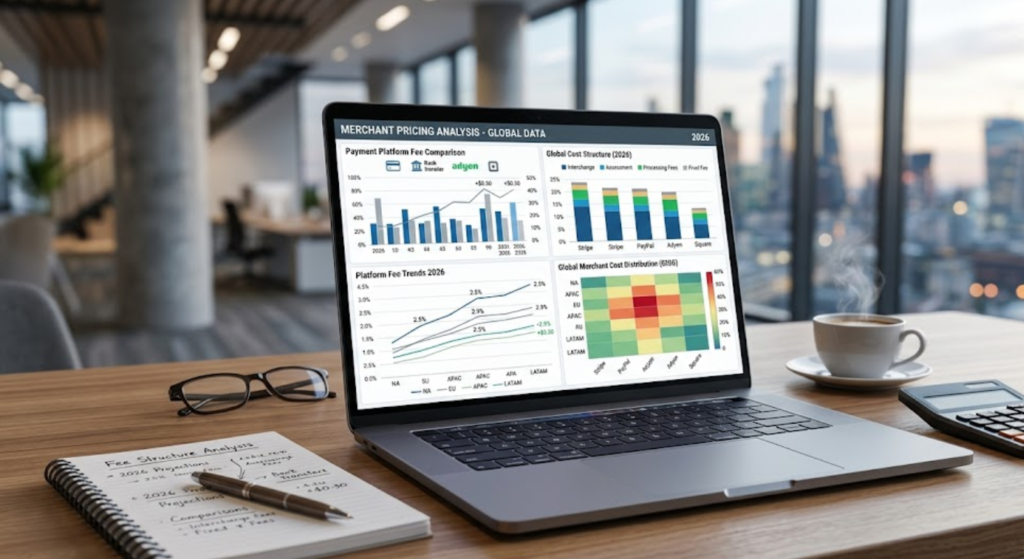
European merchants benefit from significantly lower interchange rates mandated by EU regulation — interchange on consumer debit cards in the EU is capped at 0.2% and consumer credit cards at 0.3%, compared to US rates that can be ten times higher. This regulatory cap flows through to lower MDR for European merchants, particularly at platforms like Adyen and Checkout.com that build regional pricing around local interchange.
Asia-Pacific markets present both opportunities and complexity. Local payment methods — Alipay, WeChat Pay, PayNow, PromptPay, GrabPay — are dominant in their respective markets and have different fee structures from card networks. Platforms with strong Asia-Pacific local acquiring and local payment method support (Adyen, Checkout.com, Stripe in supported markets) can offer significantly better rates than platforms routing all Asia-Pacific transactions as cross-border card payments.
Latin American markets are characterized by high local card processing fees driven by card network pricing, high installment payment preferences (particularly in Brazil where parcelado multi-installment payments are standard), and regulatory complexity that makes local acquiring partnerships essential for cost-competitive processing. Merchants with significant Latin American volume should evaluate processors with established local acquiring operations in the region rather than relying on cross-border processing at full international surcharge rates.
Beyond Processing Fees: The Total Cost of Payment Platform Ownership
Processing fees are the most visible cost of payment platform ownership but not the only one. Several additional cost dimensions deserve consideration in a comprehensive platform comparison.
Integration and Development Costs
Platforms with robust developer APIs and pre-built integrations with common e-commerce and accounting platforms (Stripe, Square, Braintree) reduce integration time and cost relative to platforms requiring more custom development work. For businesses without significant technical resources, the out-of-the-box integration quality of a platform can represent a cost difference of tens of thousands of dollars in development investment that partially offsets higher processing fees.
Chargeback and Dispute Management Costs
Chargeback fees — typically $15–$25 per dispute regardless of outcome — accumulate significantly for merchants in high-dispute industries. Square’s no-chargeback-fee policy is a meaningful differentiator for these merchants. Beyond the direct fee, the time and operational cost of managing disputes through a platform’s interface varies; platforms with strong chargeback management tooling reduce the labor cost of dispute response.
Payout Timing and Cash Flow Impact
Standard settlement timing of 1–2 business days is universal across major platforms, but instant payout options — available on Square, Stripe, and PayPal for an additional fee (typically 1–2% of payout amount) — have a cash flow value that may justify the fee in specific business contexts. For businesses with tight working capital or seasonal cash flow challenges, the availability and cost of faster settlement is a genuine economic consideration.
Contract Terms and Exit Costs
Consumer-facing platforms like Stripe and Square operate month-to-month with no long-term contracts — exit costs are essentially zero. Enterprise platforms including Worldpay and some direct acquiring relationships involve multi-year contracts with early termination fees that can be significant. The contractual flexibility of consumer-oriented platforms has real option value, particularly for growing businesses whose transaction profile is evolving and whose optimal platform may change as volume increases.
How to Conduct Your Own Platform Comparison
The most reliable comparison is one calibrated to your specific transaction data rather than hypothetical scenarios. The following process produces an accurate, actionable comparison for any merchant considering a platform switch or initial platform selection.
First, gather three to six months of transaction data from your current processor — or estimate it if you are a new business. The data you need: total processing volume, number of transactions, breakdown by card type where available (debit vs. credit, domestic vs. international), average transaction value, and monthly chargeback count.
Second, calculate your current effective rate by dividing total fees paid by total volume processed. This is your baseline against which any alternative must be compared.
Third, apply each platform’s fee structure to your actual transaction profile — not their simplified example — calculating the estimated monthly cost for each platform including percentage fees, fixed per-transaction fees, international surcharges (applied to your actual percentage of international transactions), monthly platform fees, and expected chargeback fees based on your historical dispute rate.
Fourth, contact any platform where you believe custom pricing may be available given your volume and request a custom quote, framing the conversation around your specific transaction data. A representative 90-day statement showing your volume, transaction count, and card mix gives the platform’s sales team the information they need to provide a meaningful quote rather than directing you to the published standard rates.
Fifth, factor in the non-fee costs and benefits: integration quality, hardware requirements and costs, software value, contractual terms, and the switching cost of migrating payment infrastructure if changing platforms. A platform that saves $300 per month but requires $15,000 in development work to integrate has a 50-month payback period — which may or may not be acceptable depending on your growth trajectory and the reliability of the projected savings.
The Bottom Line
The payment platform market in 2026 is more competitive and more transparent than it has ever been, and the tools to conduct a genuinely informed comparison are available to merchants of any size. The merchants who pay the most are those who accepted the default option at onboarding and never revisited the decision as their business grew and their negotiating position improved. The merchants who pay the least are those who understood their transaction profile, calculated their effective rate, compared alternatives methodically, and negotiated from a position of informed clarity about what their business is worth to a payment processor.
For most small businesses, the practical starting point is to calculate your current effective rate and compare it to what the same volume would cost on one or two alternative platforms. The difference is almost always more significant than expected — and the action required to capture it is almost always simpler than feared.
Disclaimer: This article is for educational and informational purposes only. Payment platform fees, pricing structures, and terms of service change frequently. All fee figures cited reflect publicly available information as of early 2026 and may have changed since publication. Always verify current pricing directly with each provider before making any business decisions. This article does not constitute financial, legal, or business advice. Consult qualified advisors for guidance specific to your business circumstances.